
5 Google Ads Mistakes That Are Wasting Your Budget in 2026
Introduction
Google Ads is still one of the fastest ways to reach people who are actively searching for your products or services. It can generate traffic, leads, and sales quickly, which is why so many businesses rely on it. But while the platform is powerful, it is also easy to waste money if campaigns are not structured and managed properly.
The main reason many advertisers struggle is not that Google Ads does not work. It is that they launch campaigns with weak keyword targeting, poor landing pages, and little ongoing optimization. In 2026, this problem is even more noticeable because automation and AI-driven bidding can magnify both good and bad decisions. If the foundation of your campaign is weak, automation will not fix it.
This article breaks down five Google Ads mistakes that continue to drain budgets in 2026 and shows you exactly how to correct them. If you want to improve Google Ads performance, reduce Google Ads cost, and get better results from your ad spend, these are the issues you need to fix first.
1: Choosing the Wrong Keywords
Keywords are the starting point of every Google Ads campaign. They determine when your ads appear and which users see them. If you choose the wrong keywords, your ads may reach people who are curious but not ready to buy, or worse, people who are looking for something completely different.
A common mistake is targeting broad terms because they have high search volume. At first glance, that may seem like a smart move. More searches should mean more clicks, right? In reality, broad keywords often bring in low-intenttraffic that clicks but does not convert. That means your budget gets spent without creating meaningful business results.
For example, if you sell premium office chairs and target a keyword like “chair,” your ad could show up for searches about dining chairs, gaming chairs, school chairs, or chair repair. None of those users may be looking for what you sell. The click happens, the budget is charged, and the chance of conversion stays low.
The better approach is to focus on intent. A keyword like “buy ergonomic office chair online” is much more specific and signals a stronger buying interest. This is why long-tail keywords often perform better for Google Ads optimization. They may have lower search volume, but they usually attract more qualified traffic.
To fix this mistake, build keyword groups around specific products, services, or search intentions. Keep your ad groups tight, make sure the ad copy matches the keyword theme, and review search terms regularly. That way, you can identify which terms are actually producing conversions and which ones are simply consuming budget.
2: Ignoring Negative Keywords
One of the easiest ways to waste ad spend is to forget about negative keywords. Many advertisers focus only on what they want to target and do not block what they want to avoid. As a result, their ads may appear for irrelevant or low-value searches that never lead to sales.
Negative keywords help Google Ads avoid showing your ads to the wrong audience. They are especially important for businesses that sell premium, paid, or service-based offers. Without them, you may end up paying for clicks from people who are looking for free resources, job opportunities, tutorials, or downloads instead of your actual product or service.

For instance, if you offer paid digital marketing training, you probably do not want clicks from searches like “free digital marketing course,” “digital marketing PDF,” or “online marketing internship.” Those users have a different goal, so showing them your ad is unlikely to produce a conversion. This is a classic PPC advertising mistake that can quietly drain budget over time.
The solution is simple but important: maintain a growing list of negative keywords. Review your search terms report often, identify irrelevant queries, and add exclusions before they continue wasting spend. This is one of the most practical Google Ads tips for improving campaign efficiency.
Common negative keywords may include:
- Free
- Jobs
- Salary
- Internship
- Download
- DIY
- Sample
Using negative keywords well can improve click quality, reduce wasted impressions, and support better Google Ads conversion optimization. It also makes your campaign data cleaner, which helps you make better decisions later.
3: Sending Traffic to a Weak Landing Page
A strong ad is only half the job. If the landing page does not match the ad, users will leave quickly. Many businesses spend time and money creating ads, but then send all traffic to a generic homepage that does not continue the message in the ad.
That is a problem because people click ads expecting relevance. If your ad promises a specific offer and the landing page gives them something broad or unrelated, trust drops immediately. The visitor now has to search for the right information, and many will simply exit instead of taking action.
Imagine clicking an ad for “50% off running shoes” and landing on a homepage filled with jackets, socks, backpacks, and unrelated categories. Even if the offer exists somewhere on the site, the extra effort creates friction. That friction lowers conversion rates and increases your overall cost per acquisition.

The fix is to build dedicated landing pages for specific campaigns. If your ad promotes SEO services, the visitor should land on an SEO service page. If your ad promotes web design, the landing page should focus on web design. Matching the ad to the page improves relevance and usually leads to better performance.
- A good landing page should include:
- A clear headline that matches the ad.
- A focused offer or service.
- Fast page load speed.
- Mobile-friendly design.
- A strong call to action.
- Testimonials or trust signals.
- Simple navigation without distractions.
This is one of the most important Google Ads campaign optimization principles because landing page quality can directly influence whether traffic turns into revenue.
4: Not Tracking Conversions
Many advertisers still judge campaign success by clicks alone. That is one of the biggest Google Ads mistakes because clicks do not pay the bills. Conversions do. If you are not tracking meaningful actions, you cannot tell whether your ads are actually generating business.
Without conversion tracking, you are essentially guessing. You may know how many people clicked, but you will not know which keyword led to a sale, which ad generated a lead, or which audience converted best. That makes it very difficult to optimize budgets or improve performance in a meaningful way.
Conversion tracking allows you to measure actions such as purchases, form submissions, phone calls, appointments, and newsletter signups. Once that data is in place, you can see which campaigns deserve more budget and which ones need to be paused or reworked. This gives you a much clearer picture of your true return on investment.
It also helps automation work better. Google’s bidding systems perform best when they have reliable conversion data to learn from. If the tracking is incomplete or inaccurate, the system may optimize toward the wrong signals. That is why conversion tracking is not just a reporting feature; it is a core part of Google Ads best practices.
- To improve results, make sure you:
- Track every important action on your site.
- Use clear conversion definitions.
- Connect Ads with analytics tools where appropriate.
- Review conversion data regularly.
- Compare campaign performance based on outcomes, not just clicks.
If you want to improve Google Ads performance, this step is non-negotiable. Accurate conversion tracking gives you the evidence needed to make better decisions.
5: Not Optimizing Campaigns
A Google Ads campaign should never be treated as something you create once and forget about. Many advertisers make that mistake, then wonder why performance drops or spending goes up without better results. In reality, campaigns need regular attention because search behavior changes, competitors adjust their bids, and customer interests shift over time.
Optimization is not just about changing bids. It also means trying different ad headlines, improving keyword targeting, checking which devices perform best, reviewing location data, adjusting ad timing, and looking closely at audience behavior. Even small changes can lead to better results when you make them consistently.
For example, one ad headline may attract more clicks because it speaks more clearly to what the user wants. Another keyword may bring in fewer visitors but produce higher-quality leads. You may also notice that mobile users convert better during certain hours, while desktop users respond more strongly at different times. You only discover these patterns when you review the data regularly.
A common reason businesses waste money on Google Ads is that they only focus on the launch stage. Once the campaign is live, they stop monitoring it closely. That usually leads to poor performance and wasted budget. The advertisers who get the best results are the ones who keep testing, adjusting, and improving over time.
To stay on top of campaign performance, keep an eye on:
- Click-through rate.
- Cost per click.
- Conversion rate.
- Cost per acquisition.
- Search terms.
- Device performance.
- Audience segments.
- Ad schedule performance.
Consistent optimization helps you reduce waste, improve relevance, and put your budget into the parts of the campaign that actually bring results.
Additional Google Ads Best Practices
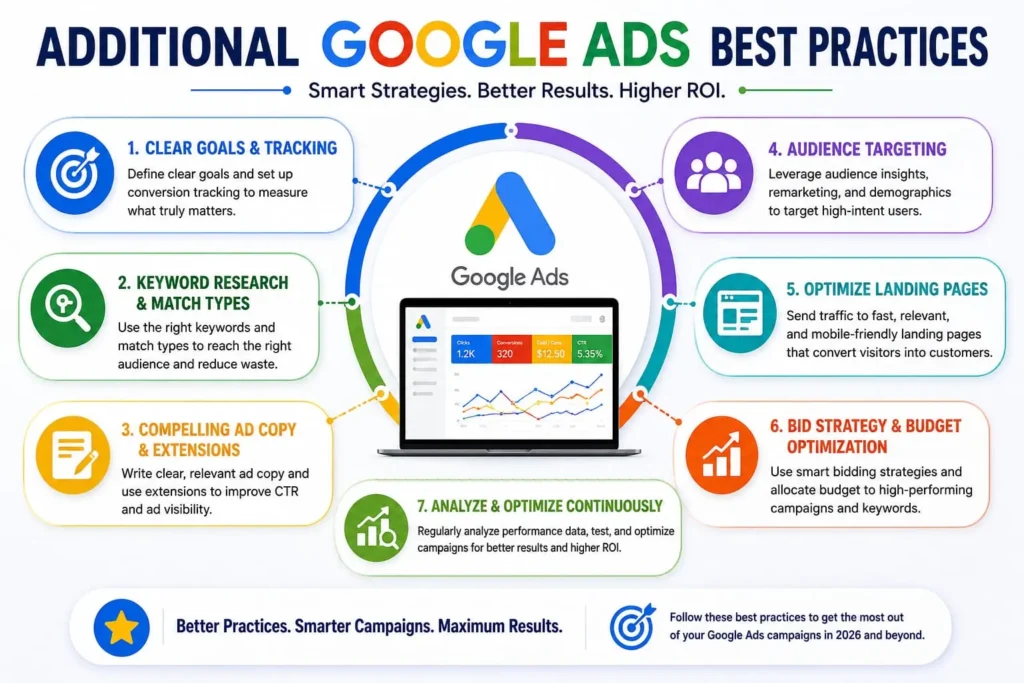
Avoiding common mistakes is only part of building a successful Google Ads campaign. To get better long-term results, you also need to follow a few smart practices that improve visibility, relevance, and user experience.
Start with ad copy that is clear and convincing. Your ad should immediately tell people what you offer, what problem you solve, and why they should choose you. When the message is too broad or generic, it is easy for users to ignore it. But when your wording is focused and specific, it becomes much more likely to grab attention and earn clicks.
Another important factor is quality score. Google tends to favor ads that are closely aligned with the search term and the landing page. When your keyword, ad message, and page content all match well, your campaign usually becomes more efficient. This can help improve ad performance and lower the amount you pay per click over time.
Ad extensions are also worth using whenever they fit your campaign goals. They give you extra space to share useful details such as links to important pages, your phone number, your location, or pricing information. These additions make your ad more helpful to searchers and can increase the chances that they interact with your business.
Mobile experience should not be overlooked either. A large share of searches now happen on phones, so your landing pages need to work well on smaller screens. Pages should load quickly, text should be easy to read, and buttons should be simple to tap. Forms should also be short and easy to complete, especially for users who are browsing on the go.
When you combine strong ad copy, good quality score, useful extensions, and a mobile-friendly experience, your Google Ads campaigns become much more effective. These small improvements may seem simple, but they can make a real difference in performance, cost, and conversions over time.
Final Thoughts
Google Ads can be a powerful way to grow your business, but only when it is managed with care and regular attention. If campaigns are left on autopilot, costs can rise quickly while results stay weak. The most common reasons for poor performance usually come down to simple issues like targeting the wrong keywords, forgetting negative keywords, sending traffic to the wrong page, not tracking conversions properly, and failing to improve campaigns over time.
The encouraging part is that these problems can be corrected. When you choose keywords more carefully, narrow your audience, build landing pages that match your ads, and measure the actions that actually matter, your campaigns become much more efficient. Ongoing testing and refinement can also help you spend less wastefully and get better value from every click.
In the end, successful Google Ads advertising is not about spending more. It is about making smarter decisions and improving the campaign step by step. That is what turns ad spend into real business growth.